
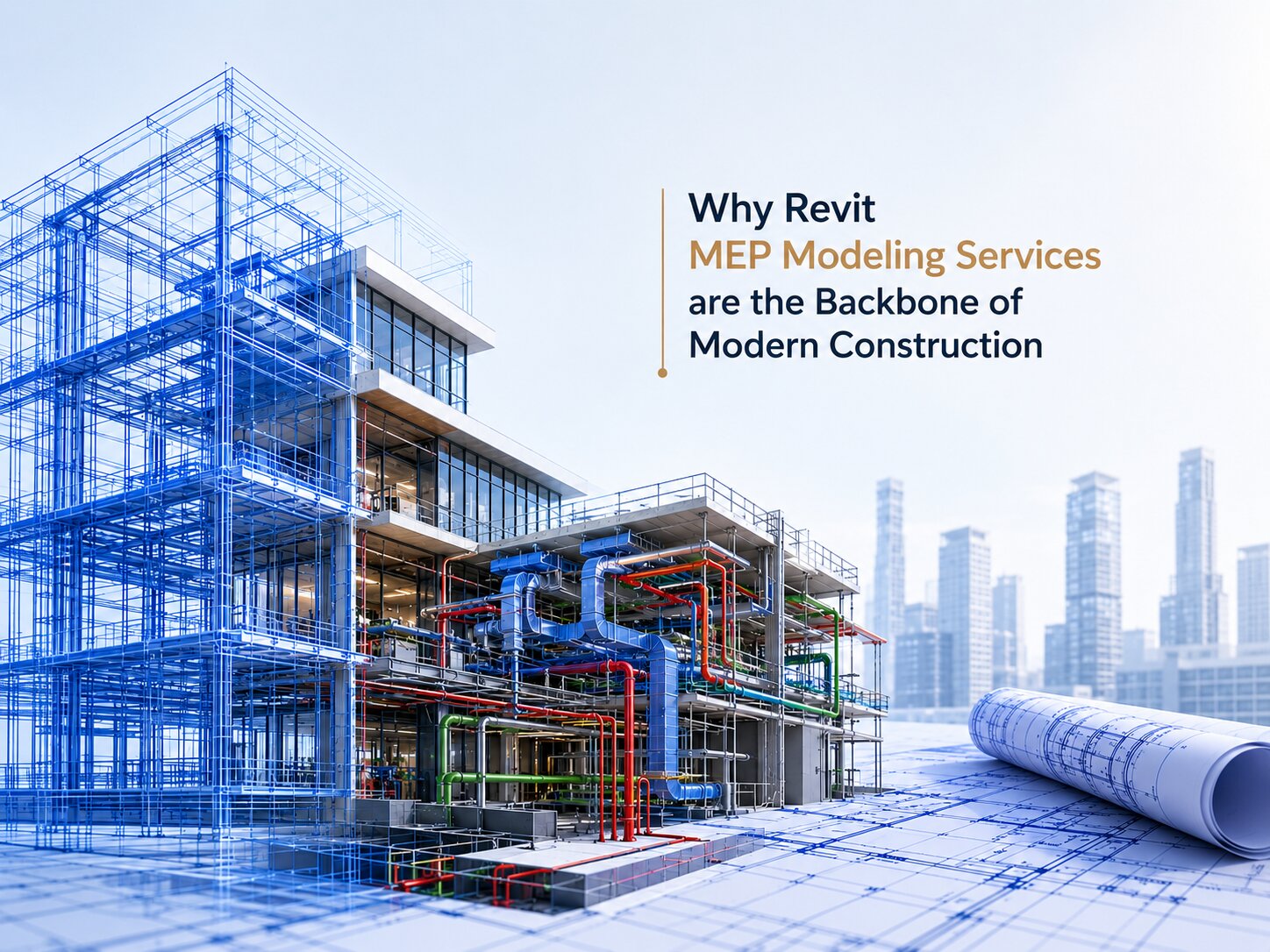
In the past, constructing a building was a game of architectural blueprint supremacy. The structure was drawn, the concrete was poured, and then mechanical, electrical, and plumbing (MEP) contractors were left to fight for space in the ceilings and walls.
The result? Costly onsite re-work, delayed timelines, and a lot of finger-pointing.
Today, modern construction doesn’t leave things to chance. With complex sustainable designs and tight spatial tolerances, Revit MEP modeling services have transitioned from a “nice-to-have digital twin” to an absolute necessity. Building Information Modeling (BIM) for MEP systems allows engineers, architects, and contractors to build, test, and troubleshoot a structure virtually before a single shovel hits the dirt.
Here is an in-depth look at why MEP BIM services are rewriting the rules of successful construction delivery.
What Are Revit MEP Modeling Services?
MEP stands for Mechanical, Electrical, and Plumbing — the three core building systems that determine whether a structure is functional, safe, and livable. Revit MEP Modeling Services refer to the process of designing, coordinating, and documenting these systems digitally in 3D using Autodesk Revit software.
But here’s the thing — it’s not just about 3D drawing. Revit creates what’s called a BIM an intelligent, data-rich model where every pipe, duct, conduit, and fitting carries real-world data like dimensions, material specs, load requirements, and cost estimates.
When you bring MEP Coordination in Construction into this BIM environment, you’re no longer working with flat drawings that teams interpret differently. You’re working in a shared, live BIM model of the building — before a single shovel hits the ground.
What Does a Revit MEP Model Actually Include?
A complete Revit MEP model typically covers:
- Mechanical systems — HVAC systems, ductwork, air handling units, chillers, cooling towers
- Electrical systems — Power distribution, lighting layouts, cable trays, conduit routing, switchgear
- Plumbing systems — Domestic water supply, drainage, sanitary systems, hot water systems
- Fire Protection systems — Sprinkler networks, fire suppression layouts (often included as MEP-FP)
All of these systems are modeled in the same environment, which means every team — mechanical, electrical, plumbing, structural, architectural — can see exactly how everything fits together.
The Real Importance of MEP BIM in Today's Construction Industry
Why are general contractors and developers demanding BIM workflows early in the design phase? The answer boils down to predictability, risk mitigation, and the bottom line.
1. Eliminating Field Friction with MEP Coordination in Construction
One of the most critical phases of pre-construction is MEP coordination in construction. When individual trades design their systems in isolation, a major HVAC duct will inevitably slice right through a structural steel beam or a plumbing line.
By utilizing Revit, all trades collaborate within a federated model. Advanced clash detection tools catch these spatial conflicts digitally. Resolving a clash on a computer screen costs a few clicks; resolving it on a construction site requires jackhammers, re-ordering materials, and weeks of delay.
2. Boosting Material Accuracy and Prefabrication
Revit MEP models can be developed to a high Level of Development (LOD 400), meaning the digital components precisely mimic the real-world fabrications. This allows contractors to prefabricate complex duct assemblies and plumbing spools offsite in a controlled factory environment. Prefabrication accelerates the project timeline, reduces on-site waste, and significantly improves safety
3. Streamlining Lifecycle Management and Facility Operations
The value of a Revit MEP model doesn’t expire when construction ends. The data-rich “As-Built” model is handed over to facility managers. If a valve leaks ten years from now, the maintenance team doesn’t have to tear down drywall blindly. They can look at the BIM model to find the exact model number, installation date, and shut-off location.
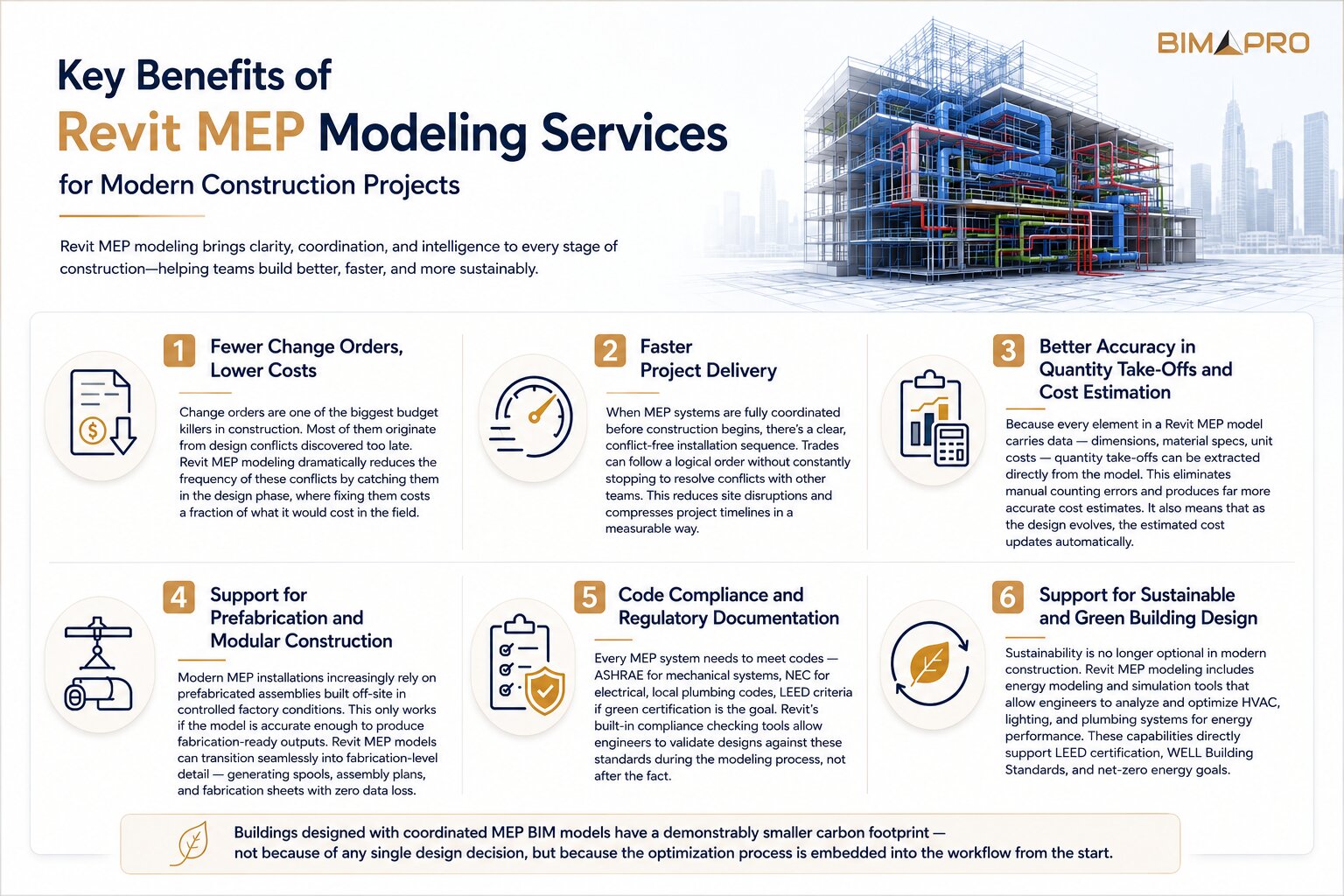
Key Benefits of Revit MEP Modeling Services for Modern Construction Projects
1. Fewer Change Orders, Lower Costs
Change orders are one of the biggest budget killers in construction. Most of them originate from design conflicts discovered too late. Revit MEP modeling dramatically reduces the frequency of these conflicts by catching them in the design phase, where fixing them costs a fraction of what it would cost in the field.
2. Faster Project Delivery
When MEP systems are fully coordinated before construction begins, there’s a clear, conflict-free installation sequence. Trades can follow a logical order without constantly stopping to resolve conflicts with other teams. This reduces site disruptions and compresses project timelines in a measurable way.
3. Better Accuracy in Quantity Take-Offs and Cost Estimation
Because every element in a Revit MEP model carries data — dimensions, material specs, unit costs — quantity take-offs can be extracted directly from the model. This eliminates manual counting errors and produces far more accurate cost estimates. It also means that as the design evolves, the estimated cost updates automatically.
4. Support for Prefabrication and Modular Construction
Modern MEP installations increasingly rely on prefabricated assemblies built off-site in controlled factory conditions. This only works if the model is accurate enough to produce fabrication-ready outputs. Revit MEP models can transition seamlessly into fabrication-level detail — generating spools, assembly plans, and fabrication sheets with zero data loss.
5. Code Compliance and Regulatory Documentation
Every MEP system needs to meet codes — ASHRAE for mechanical systems, NEC for electrical, local plumbing codes, LEED criteria if green certification is the goal. Revit’s built-in compliance checking tools allow engineers to validate designs against these standards during the modeling process, not after the fact.
6. Support for Sustainable and Green Building Design
Sustainability is no longer optional in modern construction. Revit MEP modeling includes energy modeling and simulation tools that allow engineers to analyze and optimize HVAC, lighting, and plumbing systems for energy performance. These capabilities directly support LEED certification, WELL Building Standards, and net-zero energy goals.
Buildings designed with coordinated MEP BIM models have a demonstrably smaller carbon footprint — not because of any single design decision, but because the optimization process is embedded into the workflow from the start.
Frequently Asked Questions (FAQs) About Revit MEP Modeling Services
1: What exactly is Revit MEP Modeling and how is it different from regular CAD drafting?
Traditional CAD drafting produces flat, 2D drawings that represent what systems look like on paper. Revit MEP Modeling creates an intelligent 3D model where every component carries real data — dimensions, material specs, performance parameters, and cost. This means the model can be analyzed, coordinated across disciplines, used for quantity take-offs, and updated automatically when changes are made. CAD tells you what something looks like. Revit MEP tells you what it is and how it connects to everything else.
2: How does MEP BIM reduce construction costs in practice?
The primary cost savings come from three areas: (1) Clash detection eliminates expensive rework that happens when systems conflict on site. (2) Accurate, model-based quantity take-offs reduce estimation errors and waste. (3) A coordinated installation sequence reduces idle time and rework between trades. Industry research consistently shows that every dollar invested in BIM coordination returns multiple dollars in saved rework and change order costs.
3: Is Revit MEP Modeling only suitable for large construction projects?
No. While the ROI is most dramatic on large, complex projects like hospitals, data centers, and high-rise buildings, Revit MEP Modeling Services are now routinely used on mid-scale commercial and multi-family residential projects. The key factor isn’t project size — it’s the density and complexity of MEP systems relative to available space and the number of coordinating trades involved.
4: What is the difference between MEP design and MEP coordination?
MEP design refers to the engineering work of specifying and sizing systems — determining duct sizes, calculating electrical loads, selecting equipment. MEP coordination refers to the spatial coordination of all those designed systems with each other and with the building’s structure and architecture. Revit MEP Modeling Services support both activities, but MEP Coordination in Construction is where the BIM environment provides its most visible value: ensuring everything physically fits together without conflicts.
5: Can Revit MEP models be used after construction is complete?
Absolutely — and this is one of the most underutilized aspects of BIM MEP investment. As-built Revit MEP models serve as the foundation for facility management: locating system components, planning maintenance, managing renovations, and integrating with building automation systems. In smart building environments, MEP models are increasingly connected to live IoT sensor data, creating a dynamic digital twin of the building’s operating systems.
6: How does Revit MEP Modeling support green building certification like LEED?
Revit MEP includes built-in energy modeling and simulation tools that allow engineers to optimize HVAC, lighting, and plumbing systems for energy efficiency during the design phase. This supports documentation requirements for LEED certification and other sustainability standards. By integrating rainwater harvesting design, efficient fixture selection, solar studies, and energy load simulations directly into the MEP model, teams can target green building goals from the earliest stages of design — rather than retrofitting sustainability at the end.
Conclusion: In Modern Construction, Revit MEP Modeling Isn't Optional Anymore
Revit MEP Modeling Services give construction teams the intelligence, coordination, and confidence they need to deliver these buildings right the first time. From eliminating costly clashes before construction begins, to enabling prefabrication, supporting green certification, and creating digital assets that serve buildings for decades — the importance of MEP BIM extends across every phase of a project’s lifecycle.
The teams and organizations that embrace BIM MEP Systems Design today aren’t just staying competitive — they’re setting the benchmark for the future of construction.
At BIMPRO LLC, we understand that successful projects are built on precision, coordination, and forward-thinking technology. Our expertise in Revit MEP BIM Services helps clients streamline workflows, reduce risks, and deliver high-performance buildings with confidence. By combining technical excellence with practical industry insight, BIMPRO partners with you to turn complex designs into coordinated, constructible, and future-ready solutions.
About the Author

Jinisha P
inSALES MANAGER
Jinisha Patel is a Sales Manager at BIMPRO LLC with hands-on industry exposure to BIM, Revit, and digital construction workflows. Working closely with AEC firms and project teams has given her a strong understanding of BIM coordination, multidisciplinary collaboration, project requirements, and emerging construction technologies. She writes to turn complex BIM concepts and industry developments into practical insights for AEC professionals.
Contact BIMPRO LLC
