
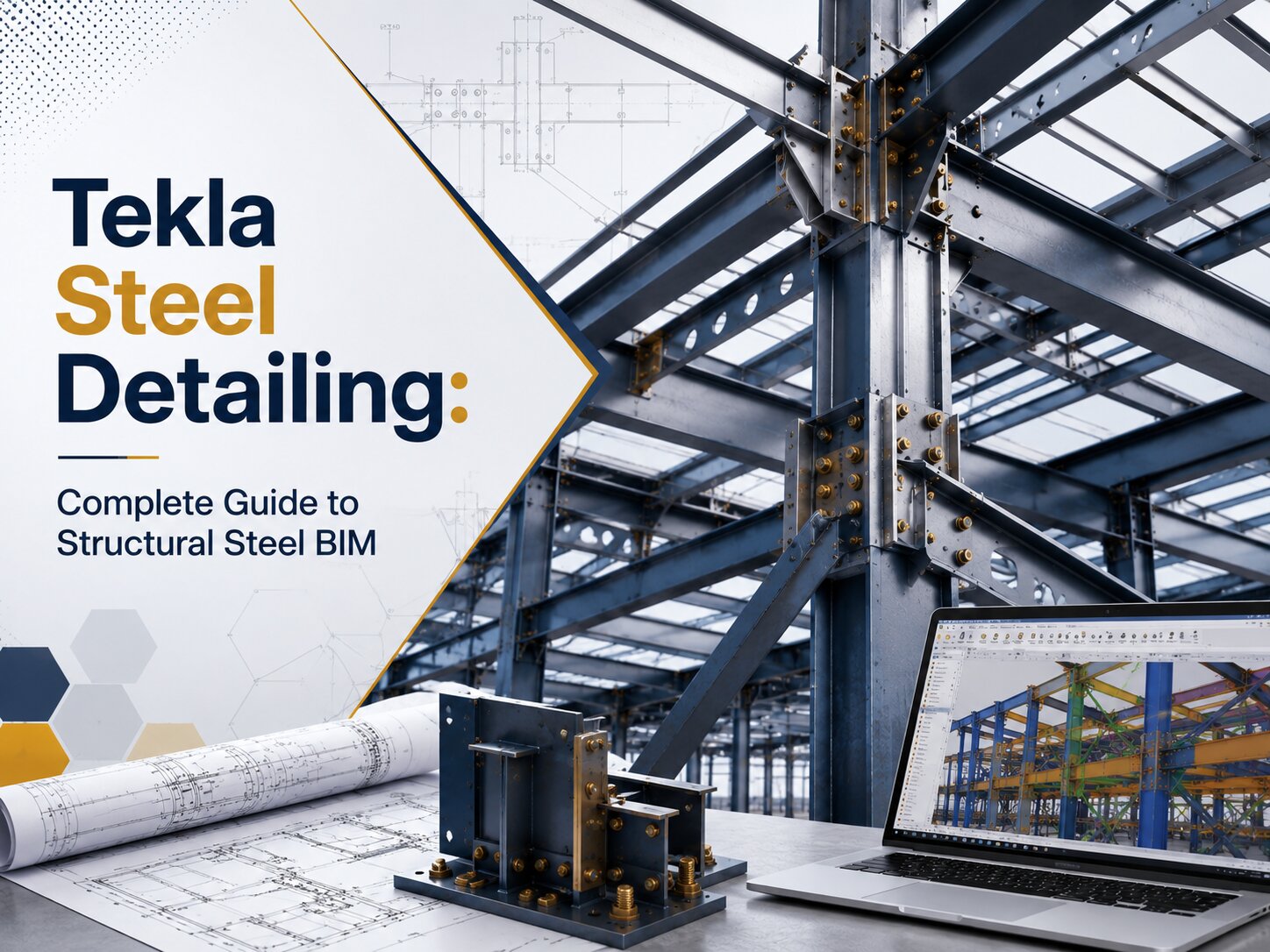
Introduction To Tekla Steel Detailing
Structural steel is the backbone of many of today’s most complex construction projects. From commercial office buildings and hospitals to manufacturing plants, airports, stadiums, and data centers, steel provides the strength, flexibility, and speed needed to bring ambitious designs to life. However, the success of these projects depends on much more than the structural design itself. Every beam, column, brace, connection, plate, and bolt must be accurately detailed before fabrication and installation can begin.
This is where Tekla Steel Detailing plays a critical role.
Tekla-based steel detailing creates intelligent, information-rich 3D models that serve as the single source of truth throughout fabrication and construction. Detailers can generate fabrication-ready shop drawings, automate material quantities, produce CNC files for manufacturing, coordinate with other building systems, and manage design revisions more efficiently than ever before.
As construction projects become increasingly complex, owners, contractors, fabricators, and engineers are relying on BIM to improve collaboration and reduce costly project risks. Tekla Structures has become one of the industry’s most trusted platforms for structural steel detailing because it combines highly accurate 3D modeling with detailed fabrication information and seamless integration into modern BIM workflows.
In this comprehensive guide, you’ll learn:
- What Tekla Steel Detailing is
- Why it has become the industry standard for structural steel projects
- How the detailing process works from design through fabrication and erection
- The types of deliverables generated from Tekla models
- How BIM improves steel detailing accuracy
- The benefits for contractors, engineers, fabricators, and project owners
- Common challenges and best practices for successful implementation
Whether you’re a structural engineer, steel fabricator, contractor, architect, or project manager, understanding Tekla Steel Detailing can help you make better decisions throughout the construction lifecycle.
What Is Tekla Steel Detailing?
Tekla Steel Detailing is the process of creating highly accurate, fabrication-ready structural steel models and construction documentation using Tekla Structures, an advanced BIM software platform specifically developed for structural engineering and steel construction.
Tekla Structures develops intelligent three-dimensional models containing both geometric and non-geometric information. Every structural component in the model—including beams, columns, braces, base plates, stiffeners, gusset plates, bolts, welds, and custom connections—contains detailed data that can be used throughout the project lifecycle.
A Tekla model is far more than a visual representation of a structure. It acts as a centralized digital model that supports engineering, fabrication, logistics, installation, quantity takeoffs, scheduling, and project coordination.
Because every object within the model contains embedded information, updates made during design automatically propagate throughout related drawings, schedules, and reports. This significantly reduces manual drafting work and minimizes the risk of inconsistencies.
Why Is Steel Detailing So Important?
Before steel components can be fabricated, every structural member must be translated from engineering intent into precise manufacturing information.
Structural engineers design the building to meet safety, performance, and code requirements. Their drawings communicate the overall structural system but typically do not include every fabrication detail required by steel manufacturers.
Steel detailers bridge this gap. Their responsibility is to transform engineering designs into fabrication-ready documentation by defining exact member sizes and locations, connection details, plate dimensions, bolt specifications, weld information, material grades, assembly sequencing, erection references, fabrication tolerances.
BIM transformed the steel detailing process by replacing disconnected drawings with coordinated 3D models. Instead of drawing every view separately, detailers model the actual steel members once. Drawings, schedules, reports, and fabrication information are then generated directly from the model.
Why Tekla Structures Is the Industry Standard for Steel Detailing
Not every BIM platform is designed for fabrication-level structural detailing. Many BIM tools are excellent for design coordination but do not provide the depth of functionality required by steel fabricators. Tekla Structures stands out because it supports the entire steel construction process—from conceptual design through fabrication and field installation. Read the full guide of Tekla Structures Services and understand why Tekla is default choice of structural detailers for structural projects. Some of its key capabilities include:
1. Intelligent Parametric Modeling
Every object in a Tekla model behaves as an intelligent component rather than a collection of lines. Changing the size of a beam, modifying a connection, or updating a structural member automatically updates associated drawings and reports. This dramatically reduces manual coordination.
2. Fabrication-Level Accuracy
Tekla enables detailers to model structures exactly as they will be fabricated. This includes weld preparations, bolt assemblies, plates, cuts, copes, chamfers, connection hardware, surface treatments, assembly information
3. Automated Shop Drawings
One of Tekla’s greatest strengths is its ability to generate detailed shop drawings directly from the model. Rather than manually producing every drawing, detailers can automatically create documentation for single parts, assemblies, general arrangement drawings, anchor bolt plans, erection drawings, material reports, bolt lists, weld schedules.
4. Improve Collaboration and Coordination
Today’s construction project involves architects, structural engineers, MEP consultants, fabricators, contractors, and owners working together. Tekla models integrate into BIM coordination workflows, allowing structural steel to be coordinated with mechanical, electrical, plumbing, and architectural systems before fabrication begins.
Tekla Steel Detailing Workflow: From Design Drawings to Fabrication
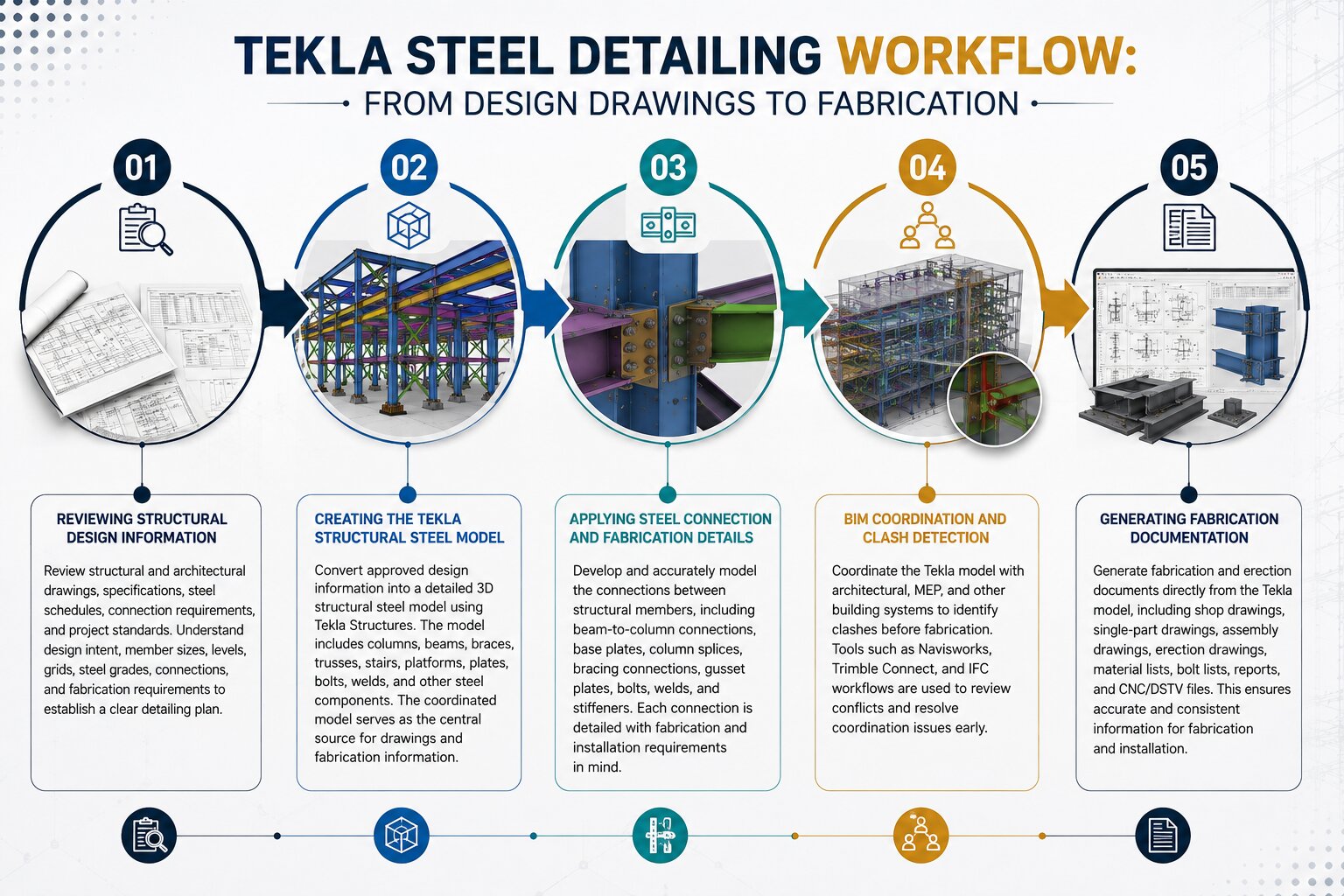
A successful structural steel project requires a coordinated process that transforms engineering intent into physical steel components. Tekla Steel Detailing plays a critical role in this transformation by connecting structural design information with fabrication and construction requirements. A typical Tekla steel detailing workflow follows a structured sequence:
1. Reviewing Structural Design Information
The process starts with reviewing structural and architectural drawings, specifications, steel schedules, connection requirements, and project standards. The detailing team studies the design intent, member sizes, levels, grids, steel grades, connections, and fabrication requirements to establish a clear detailing plan.
2. Creating the Tekla Structural Steel Model
The approved design information is converted into a detailed 3D structural steel model using Tekla Structures. The model includes columns, beams, braces, trusses, stairs, platforms, plates, bolts, welds, and other steel components. The coordinated model serves as the central source for drawings and fabrication information.
3. Applying Steel Connection and Fabrication Details
Detailers develop and accurately model the connections between structural members, including beam-to-column connections, base plates, column splices, bracing connections, gusset plates, bolts, welds, and stiffeners. Each connection is detailed with fabrication and installation requirements in mind.
4. BIM Coordination and Clash Detection
The Tekla model is coordinated with architectural, MEP, and other building systems to identify clashes before fabrication. Tools such as Navisworks, Trimble Connect, and IFC workflows can be used to review conflicts and resolve coordination issues early.
5. Generating Fabrication Documentation
Once the model is approved, fabrication and erection documents are generated directly from the Tekla model. These typically include shop drawings, single-part drawings, assembly drawings, erection drawings, material lists, bolt lists, reports, and CNC/DSTV files. This ensures accurate and consistent information for fabrication and installation.
Tekla Steel Detailing Deliverables Explained
A completed Tekla steel detailing project produces a range of fabrication and construction deliverables. These documents and digital files provide fabricators, contractors, and erectors with the information required to manufacture and install structural steel accurately.
1. Tekla Shop Drawings
Shop drawings provide detailed fabrication information for structural steel members. They typically include member marks, profiles, dimensions, material specifications, bolt and hole details, weld information, plates, cutting requirements, and fabrication notes. Since these drawings are generated from the Tekla 3D model, updates can be managed more consistently when the model changes.
2. Assembly Drawings
Assembly drawings show how individual steel components are combined into larger assemblies such as beams, columns, braced frames, stairs, and platforms. They help fabricators understand component relationships, connection details, welding requirements, dimensions, and assembly requirements.
3. Single-Part Drawings
Single-part drawings provide fabrication details for individual components such as beams, plates, columns, brackets, and custom parts. They typically include dimensions, material information, hole locations, cutting details, and weld requirements needed for accurate manufacturing.
4. General Arrangement (GA) Drawings
GA drawings provide an overall view of the structural steel framework, showing member locations, grids, elevations, floor levels, and framing arrangements. They help engineers, contractors, erectors, and project teams understand how individual steel components fit together within the overall structure.
5. CNC and DSTV Files
Tekla can generate machine-readable fabrication files that connect the detailed BIM model with automated manufacturing equipment. DSTV and NC files can contain information such as part geometry, cutting dimensions, drilling locations, and other manufacturing data. This helps improve fabrication accuracy, reduce manual input, and streamline the transition from BIM modeling to steel fabrication.
Frequently Asked Questions About Tekla Steel Detailing
1. What LOD is typically used for Tekla steel detailing?
The required LOD depends on the project and contract requirements. LOD 400 is commonly associated with fabrication-level information, while lower levels are appropriate for design and coordination.
2. Is Tekla better than Revit for steel detailing?
Revit is widely used for multidisciplinary BIM and building design, while Tekla Structures is particularly strong in detailed structural modeling, steel detailing, fabrication documentation, and constructible modeling.
3. What is a Tekla fabrication model?
A Tekla fabrication model is a detailed structural model containing the information required to support fabrication and construction. Depending on project requirements, it may include members, connections, plates, bolts, welds, cuts, assemblies, numbering, and other fabrication-related information.
4. What is included in Tekla steel detailing?
5. Can Tekla generate CNC files?
Yes. Tekla supports fabrication-oriented data exchange and CNC-related workflows used by steel manufacturers. The exact file format and machine workflow depend on the fabrication equipment and project requirements.
6. Is Tekla Structures a BIM software?
Yes. Tekla Structures is a BIM software platform used for detailed structural modeling, coordination, and construction information. As part of structural BIM services, Tekla supports open BIM workflows that allow models to exchange information with other platforms through formats such as IFC.
7. Does Tekla eliminate the need for steel detailers?
No, Tekla is a powerful tool, but software does not replace engineering understanding, fabrication knowledge, coordination experience, or professional QA/QC.
Conclusion
Structural steel detailing has evolved from manual drafting to highly connected digital workflows. Tekla Steel Detailing represents an important part of that evolution because it connects the structural model with the information needed for coordination, documentation, fabrication, and construction.
The real advantage is not simply that a steel structure can be viewed in 3D. It is that the model can become a reliable information source for the people who actually need to build the structure. For contractors, that can mean better coordination. For fabricators, it can mean more reliable fabrication information. For engineers, it can provide greater visibility into how design intent is translated into constructible steel. For project owners, it can contribute to better coordination and fewer downstream surprises. And for the construction industry as a whole, it represents a move toward more connected, data-driven project delivery.
As an experienced BIM services provider, BIMPRO supports construction teams with structural BIM modeling, Tekla detailing, BIM coordination, and fabrication-oriented modeling workflows. If your project requires detailed structural steel modeling, fabrication documentation, BIM coordination, or constructible steel models, our Tekla BIM Services can provide the technical support needed to improve coordination and project execution.
Need Tekla Steel Detailing Support?
Have an upcoming project requiring Tekla steel detailing, structural BIM modeling, shop drawings, fabrication drawings or BIM coordination? Send us your project drawings and scope at info@bimprous.com or contact our team to discuss your requirements.
About the Author

Sales Manager
Jinisha Patel is a Sales Manager at BIMPRO LLC with hands-on industry exposure to BIM, Revit, and digital construction workflows. Working closely with AEC firms and project teams has given her a strong understanding of BIM coordination, multidisciplinary collaboration, project requirements, and emerging construction technologies. She writes to turn complex BIM concepts and industry developments into practical insights for AEC professionals.
Contact BIMPRO LLC
